
Lavender in the Haute-Provence, a heady aroma when mixed with that of wild sage, thyme, clary sage and hyssop growing on the mountain side.
Septimus Piesse’s The Art of Perfumery (published in 1857) is an important early book about the methodology behind extraction methods and blending in perfumery. In the book, Piesse introduces the idea that olfaction can be described in ways that correlate to the musical notes on a diatonic scale. He invented the perfumer’s organ, also called an octophone, where the keys of a ‘piano’ activated one of 46 different odours. Piesse used music to describe how notes and smells can work together: “There is, as it were, an octave of odours like an octave in music; certain odours coincide, like the keys of an instrument.”
The practice of classifying essential oils and perfume ingredients into top, middle and base notes still forms the basis for the creation of a well-balanced perfume, and these principles may be applied to aromatherapy by selecting essential oils from each of the three categories:
Top notes: sharp and penetrating, highly volatile and the fast acting. They do not last long, but are important as they give the first impression of the blend. Generally held to be uplifting and refreshing.
Middle notes: warm, round and soft. They give body to blends, smoothing the sharp edges.
Base notes: deep, intense and profound, they seem to draw the blend into the skin thereby giving it permanence. They are also known as fixatives because they slow the evaporation of the more volatile essential oils, ensuring their fragrance lasts longer.
It could be said that, working together, the top note introduces the scent, while the middle note and the base note create the core of the aroma.

Wild thyme – Cyprus
The system originated by Piesse is still the basis for formulating fine fragrances today:
Aromatic notes are usually combinations of sage, rosemary, cumin, lavender and other plants which possess a very intensive grass-spicy aroma. They are often combined with citrusy and spicy notes.
Chypre notes are based on blends of oakmoss, labdanum, patchouli and bergamot. Incidently, Chypre means Cyprus in French.
Citrus compositions, as expected, utilise lemon, orange, bergamot, grapefruit or mandarin. Other citrusy, aromatic and tart notes are frequently added for gentlemen’s fragrances whereas floral notes are used for ladies.
Floral notes embrace numerous creations with a floral heart, utilising rose, jasmine, mimosa, geranium and tuberose for example.
Leather & tobacco notes are somewhat difficult to envisage with essential oils but blends of cedarwood, tobacco absolute, cade, cassie absolute and nagarmotha (also known as cypriol) have been used.
Oriental blends have accentuaterd warmth and sensuality, incorporating amber, musk, vanilla, resins and woods.
Woody compositions involve warm sandalwood, drier and sharper cedarwood and vetiver, along with resins and spices.
Blending for Fragrance
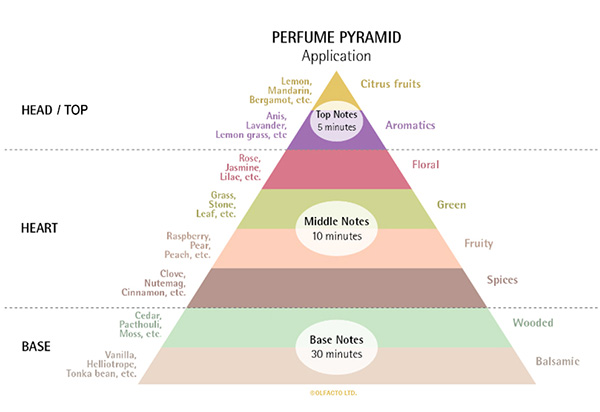
The fragrance pyramid is a composition of fragrance notes – top, middle/heart and base. Working with a fragrance pyramid can help to create a balanced scent.
An essential oil may be classified as a specific note, but will still contain some characteristics of the other two.
Top notes are light and refreshing, consisting of small, light molecules that evaporate quickly.
Middle notes, sometimes referred to as heart notes, give a fragrance its character and intensity. The scent of middle note compounds is usually more soft and rounded.
At first, the top and mid notes exist at the same time; then the middle notes become more dominant as the scent continues to mature.
Base notes are more grounding, balancing and provide depth to a scent. The base note appears within 30 minutes and can last for several hours. Essential oils belonging to this category have rich aromas, which give the scent more ‘body’, longevity and can be used as fixatives.
 naturalscienceconsultants.org